How Do You Know When to Use Mm Proposition 1 or 2
What is the M&K Theorem?
The M&M Theorem, or the Modigliani-Miller Theorem, is one of the nearly important theorems in corporate finance. The theorem was adult by economists Franco Modigliani and Merton Miller in 1958. The main idea of the M&M theory is that the uppercase construction of a company does not affect its overall value.
The first version of the M&M theory was full of limitations as it was developed under the assumption of perfectly efficient markets, in which the companies practise not pay taxes, while in that location are no defalcation costs or asymmetric information . Subsequently, Miller and Modigliani developed the 2d version of their theory by including taxes, defalcation costs, and asymmetric information.
The M&M Theorem in Perfectly Efficient Markets
This is the get-go version of the M&Grand Theorem with the assumption of perfectly efficient markets. The assumption implies that companies operating in the globe of perfectly efficient markets do not pay any taxes, the trading of securities is executed without whatsoever transaction costs, bankruptcy is possible, but in that location are no defalcation costs, and information is perfectly symmetrical.
Proposition 1 (M&M I):

Where:
- VU= Value of the unlevered firm (financing only through disinterestedness)
- VL= Value of the levered firm (financing through a mix of debt and equity)
The first proposition substantially claims that the company'due south majuscule structure does not impact its value. Since the value of a visitor is calculated as the nowadays value of future greenbacks flows, the capital letter structure cannot touch information technology. Also, in perfectly efficient markets, companies do not pay any taxes. Therefore, the company with a 100% leveraged capital letter structure does not obtain whatsoever benefits from tax-deductible interest payments.
Proposition 2 (M&G I):
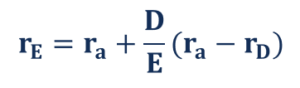
Where:
- rE= Cost of levered equity
- ra= Cost of unlevered equity
- rD= Cost of debt
- D/E = Debt-to-disinterestedness ratio
The second suggestion of the M&M Theorem states that the company's price of equity is directly proportional to the company's leverage level. An increase in leverage level induces a college default probability to a visitor. Therefore, investors tend to demand a higher cost of equity (return) to be compensated for the additional gamble.
M&M Theorem in the Real World
Conversely, the second version of the 1000&M Theorem was developed to better arrange real-world weather. The assumptions of the newer version imply that companies pay taxes; there are transaction, bankruptcy, and agency costs; and information is non symmetrical.
Suggestion 1 (Chiliad&M II):

Where:
- tc = Tax rate
- D = Debt
The first proposition states that tax shields that upshot from the revenue enhancement-deductible involvement payments brand the value of a levered company college than the value of an unlevered company. The main rationale behind the theorem is that taxation-deductible interest payments positively impact a company'southward greenbacks flows. Since a visitor's value is adamant as the present value of the future cash flows, the value of a levered company increases.
Suggestion 2 (Thousand&M II):

The 2d proposition for the existent-world condition states that the cost of equity has a directly proportional relationship with the leverage level.
Notwithstanding, the presence of revenue enhancement shields affects the relationship by making the cost of disinterestedness less sensitive to the leverage level. Although the extra debt still increases the chance of a visitor'southward default, investors are less prone to negatively reacting to the company taking boosted leverage, as it creates the taxation shields that boost its value.
More Resources
Cheers for reading CFI's guide to Modigliani-Miller Theorem. To continue learning and developing your cognition of fiscal analysis, we highly recommend the additional CFI resources beneath:
- Corporate Finance Overview
- Fiddling'due south Law
- Unlevered Toll of Majuscule
- Valuation Methods
Source: https://corporatefinanceinstitute.com/resources/knowledge/finance/mm-theorem/
0 Response to "How Do You Know When to Use Mm Proposition 1 or 2"
Post a Comment